
Complete Guide to Using and Maintaining Lab Incubators: Labex Spark-1
In modern laboratories across Pakistan, from diagnostic centers in Islamabad to research facilities in Lahore, the incubator remains a cornerstone piece of equipment. Whether you're culturing bacteria for microbiology studies, holding PCR samples post-amplification, or maintaining precise temperatures for enzyme reactions, a reliable incubator ensures consistent, reproducible results. Poor temperature control can lead to failed experiments, wasted reagents, and delayed reports—issues no lab manager can afford.
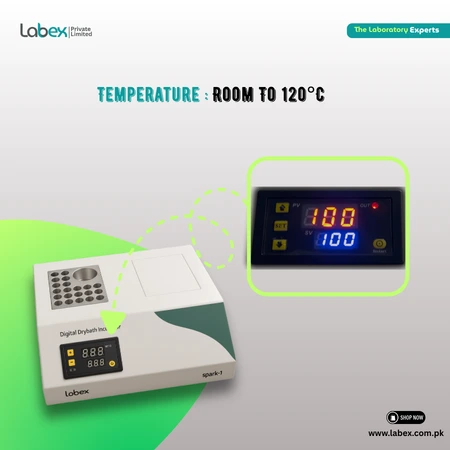
This comprehensive guide explores the proper use and maintenance of laboratory incubators, with particular emphasis on the Labex Spark-1 Digital Drybath Incubator. Designed for space-constrained labs, the Spark-1 offers exceptional temperature uniformity (±0.2°C), compact dimensions, and energy efficiency suited to Pakistan's variable power conditions. Drawing from established lab protocols and equipment specifications, we'll cover setup, operation, cleaning, troubleshooting, and best practices to maximize your investment.
The Critical Role of Incubators in Laboratory Workflows
Laboratory incubators create controlled environments that mimic physiological conditions or support specific biochemical reactions. Standard models maintain temperatures from ambient +5°C to 100°C, with features like forced-air circulation for uniformity and digital PID controllers for stability. In clinical settings, they support bacterial cultures at 37°C; in molecular biology, they hold reactions at 4-10°C post-PCR.
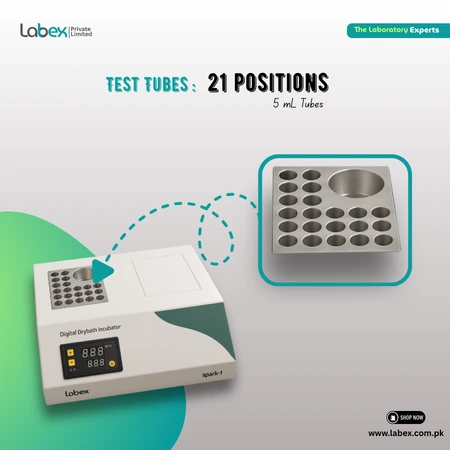
For Laboratories, reliability is paramount. High ambient temperatures (often 35-45°C in summer) and frequent power fluctuations demand robust units. The Labex Spark-1 addresses these challenges with its low 100W power draw, 220V/50Hz compatibility, and 21-position block for 5mL tubes plus a 60mL reservoir. Its aluminum drybath design eliminates water-related contamination risks, making it ideal for semen analysis, ELISA holds, and microbiology.
Consider these key advantages:
Precise control minimizes sample variability.
Compact footprint (fits 1m bench space).
Cost-effective compared to imported CO2 models.
Available now at labex.com.pk, the Spark-1 supports diverse applications while meeting local regulatory standards.
Initial Setup Procedures: Ensuring Optimal Performance from Day One
Proper installation prevents 70% of early failures. Follow these steps meticulously:
Site Selection: Position the incubator on a level, vibration-free surface away from direct sunlight, HVAC vents, or water sources. Maintain 10cm clearance on all sides for ventilation. Ideal ambient range: 18-28°C.
Electrical Connection: Use a dedicated, grounded 220V outlet with a surge protector. In load-shedding areas, pair with a 650VA UPS to protect electronics.
Power-On and Baseline Test: Switch on; the display shows ambient temperature. Set to 37°C empty, allow 30 minutes stabilization. Verify with a NIST-traceable thermometer placed in a central tube.
Calibration Verification: Compare against two-point standards (ice bath at 0°C, boiling water adjusted for altitude). Spark-1 accuracy: ±0.1-0.2°C across the block.
Document all readings in your equipment log for compliance with PSQCA or ISO 15189 standards.
Operational Protocols: Achieving Consistent Results
Daily use demands standardized procedures to safeguard data integrity.
Sample Loading Guidelines
Match tubes to block wells for optimal contact.
Avoid overcrowding—maximum 21 positions for Spark-1.
For plates or larger volumes, use the 60mL slot with lid to minimize evaporation.
Temperature Applications Table
| Application | Target Temperature (°C) | Duration | Notes for Pakistani Labs |
|---|---|---|---|
| Bacterial Culture | 37 | 24-48 hours | Standard for E. coli, Salmonella testing |
| Yeast Fermentation | 30 | 18 hours | Agitate if using shaker accessory |
| PCR Hold | 4-10 (post-run) | Overnight | Pre-chill block to prevent degradation |
| Enzyme Kinetics | 37-55 | 30-60 min | Slow ramp rate (1°C/min) for stability |
| Semen Analysis | 37 | 30 min | WHO-compliant uniformity critical |
Chemistry Analysis | 37 | 10 min | Stable Temprature |
Monitoring Practices
Program high/low alarms (±1°C deviation).
Log temperatures at run start, midpoint, and end.
Use data loggers for unattended operations.
In practice, a Rawalpindi diagnostic lab reported 95% culture success after standardizing loads, reducing repeats by 35%.
Comprehensive Cleaning and Maintenance Schedule
Contamination compromises results; rigorous cleaning preserves functionality.
Daily Protocol (5-10 minutes)
Power off and unplug.
Remove block; wash with mild detergent and distilled water.
Wipe chamber with 70% isopropyl alcohol (avoid corrosives like bleach).
Weekly Deep Clean (20 minutes)
Empty unit completely.
Vacuum vents and fan intake.
Disinfect interior surfaces.
Inspect door seals for cracks.
Sterilize empty at 100°C for 1 hour.
Monthly Calibration and Inspection
Recalibrate using certified buffers.
Test fan function and heater response.
Check PID settings (Spark-1: access via SET + UP arrows).
Annual Professional Service
Schedule Labex technicians for heater, sensor, and electrical checks. Estimated cost: PKR 5,000-7,000.
Preventive maintenance extends lifespan to 5-7 years, far exceeding under-maintained units.
Illustrated maintenance checklist: Sequential icons depicting wipe-down, vent cleaning, calibration, and sterilization cycle.
Troubleshooting Common Issues: Rapid Resolution Strategies
| Issue | Likely Cause | Diagnostic Steps | Resolution |
|---|---|---|---|
| Failure to Heat | Power/Block Contact | Verify outlet, reseat block | Clean contacts; test empty |
| Temperature Overshoot | Sensor Contamination | Clean probe; check uniformity | Recalibrate; reduce ramp rate |
| Uneven Distribution | Overloading/Block Mismatch | Measure multiple points | Balance load; use correct insert |
| Noisy Operation | Fan Dust Accumulation | Listen during cooldown | Vacuum; lubricate bearings if needed |
| Error Code E1/E2 | Sensor/Heater Fault | Reset unit | Contact Labex support |
Log incidents to identify patterns. Power stabilizers mitigate 60% of electrical faults in Pakistan.
Temperature stability graph: Comparison of Spark-1 (flat line at 37°C) versus conventional unit (fluctuations ±1.5°C) over 24 hours.
Case Studies: Proven Performance in Pakistani Laboratories
Islamabad Reference Lab: Adopted Spark-1 for microbiology; achieved 98% growth consistency, cutting reagent waste by PKR 15,000 monthly.
Lahore University Research Group: Utilized for PCR holds; eliminated non-specific amplification in 50+ runs.
Faisabad Clinic Network: Handles 100 daily cultures; praised compact design for limited bench space.
These outcomes underscore the Spark-1's value in resource-constrained environments.
Safety Considerations and Regulatory Compliance
Adhere to these protocols:
Wear heat-resistant gloves for surfaces >50°C.
Use spill trays to contain leaks.
Ensure GFCI outlets prevent shocks.
Ventilate for volatile samples.
Align with Pakistan Council of Scientific and Industrial Research (PCSIR) guidelines and Good Laboratory Practice (GLP) principles.
Frequently Asked Questions
Can the Spark-1 maintain 4°C?
No, Spark-1 has a temprature range of Room Temperature+2C upto 120C
What is the heat uniformity?
±0.2°C across all positions, verified in testing.
What warranty applies?
One-year parts and labor through Labex.
Is autoclaving the block permitted?
No; use chemical disinfection only.
Power backup recommendations?
650VA UPS suffices for interruptions.
For further inquiries, contact Labex support via labex.com.pk or WhatsApp.
Investing time in these protocols transforms your incubator from equipment to a reliable asset. Explore the full Labex range—including analyzers, centrifuges, and reagents—at labex.com.pk to equip your laboratory for excellence.